Update on 2026-09-09
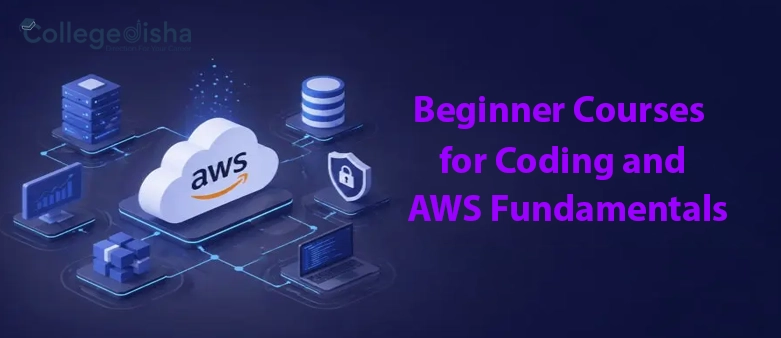
7 Beginner Courses for Coding and AWS Fundamentals
Learning to code and understanding cloud platforms often begin as separate goals, but the two skills quickly meet in practical technology work. Python helps beginners understand variables, logic, functions, testing, and automation, while AWS provides the infrastructure for running applications, storing data, and managing cloud resources.
A beginner does not need to study both subjects at the same depth immediately. One learner may start by writing short Python scripts, while another may first learn EC2, S3, IAM, and cloud service models. Familiarity with both creates a useful base for later work in software, data, DevOps, or cloud engineering.
The seven courses below provide beginner-friendly routes into Python programming and AWS fundamentals.
7 Beginner Coding and AWS Courses to Compare
1. Python Fundamentals for Beginners - Great Learning Academy
This free python course starts with variables, data types, operators, strings, and control flow before progressing into functions, object-oriented programming, file handling, regular expressions, Pytest, and coding tools.
Program Highlights: Python syntax, lists, tuples, dictionaries, loops, OOP, exception handling, files, RegEx, Pytest, Jupyter Notebook, and GitHub Copilot.
Duration: Self-paced, 3.75 hours.
Outcomes: Learners can write basic scripts, manipulate data structures, handle common errors, work with files, and test Python code.
Why to Choose this Course?
It starts from the fundamentals, so previous coding experience is not necessary.
Testing and debugging appear alongside programming basics, helping beginners develop useful coding habits early.
2. Programming for Everybody (Getting Started with Python) - University of Michigan
University of Michigan keeps the first programming experience deliberately simple. Learners install Python, write programs, and work with variables, expressions, functions, conditional logic, and loops without advanced mathematics.
Program Highlights: Python 3, variables, expressions, functions, conditional execution, loops, debugging, and basic program construction.
Duration: Self-paced, approximately 2 weeks at 10 hours per week.
Outcomes: Learners can construct simple Python programs and develop the foundation needed for further study in programming.
Why to Choose this Course?
No previous programming knowledge is expected, making it accessible to complete beginners.
The curriculum stays focused on core logic, rather than adding libraries before learners understand basic programming.
3. AWS for Beginners - Great Learning Academy
For learners who want to learn AWS free, this course begins with cloud computing and AWS infrastructure before introducing service models, compute, storage, security, scalability, and practical AWS services.
Program Highlights: IaaS, PaaS, SaaS, AWS global infrastructure, EC2, S3, IAM, Lambda, Elastic Beanstalk, load balancing, autoscaling, and an EC2 demonstration.
Duration: Self-paced, 4.5 hours.
Outcomes: Learners can explain major AWS concepts, compare cloud service models, work with basic AWS infrastructure, and understand how compute and storage services are used.
Why to Choose this Course?
No AWS or cloud background is required, allowing beginners to start from basic cloud terminology.
The EC2 demonstration adds practical context to concepts such as virtual servers and cloud deployment.
4. AWS Educate Introduction to Cloud 101 - Amazon Web Services
AWS Educate provides a direct introduction to cloud concepts for new-to-cloud learners. The training combines foundational material with practical exposure to major AWS services.
Program Highlights: Cloud service models, AWS global infrastructure, S3, EC2, DynamoDB, RDS, VPC, IAM, shared responsibility, and virtual labs.
Duration: Approximately 3 hours.
Outcomes: Learners understand core AWS services and can practice creating simple cloud applications in a virtual lab environment.
Why to Choose this Course?
The training is developed within the AWS learning ecosystem, keeping the material closely aligned with the platform itself.
Successful completion can lead to an AWS Educate training badge, providing evidence of foundational cloud learning.
5. Crash Course on Python - Google Career Certificates
Google teaches Python through the lens of automation. The course introduces syntax and programming logic before learners combine those concepts in scripts and a final programming task.
Program Highlights: Python syntax, data types, functions, conditions, loops, strings, lists, dictionaries, code reuse, debugging, automation, and scripting.
Duration: Self-paced, approximately 2 weeks at 10 hours per week.
Outcomes: Learners can write short Python scripts, automate simple actions, and organize programs using common Python structures.
Why to Choose this Course?
Automation gives beginners a practical reason to write code, rather than learning syntax without a clear application.
No previous programming experience is required, keeping the barrier to entry low.
6. AWS Cloud Technical Essentials - Amazon Web Services
This course moves beyond cloud terminology into practical infrastructure. Learners work with compute, networking, databases, security, monitoring, and storage while developing an AWS application through guided activities.
Program Highlights: IAM, EC2, Lambda, ECS, VPC, S3, RDS, DynamoDB, CloudWatch, load balancing, autoscaling, labs, and a capstone activity.
Duration: Self-paced, approximately 2 weeks at 10 hours per week.
Outcomes: Learners can select appropriate AWS services and configure the core components of a scalable, monitored cloud application.
Why to Choose this Course?
Hands-on labs cover several parts of AWS infrastructure, including compute, networking, storage, and monitoring.
It provides a practical next step after an introductory cloud study for learners interested in technical AWS roles.
7. Python for Data Science, AI & Development - IBM
IBM combines Python fundamentals with an introduction to how programming is used with data. Learners progress from syntax and control flow to files, libraries, APIs, and web-based data.
Program Highlights: Python syntax, collections, functions, classes, exceptions, files, NumPy, Pandas, Jupyter Notebooks, REST APIs, and web scraping.
Duration: Self-paced, approximately 2 weeks at 10 hours per week.
Outcomes: Learners can create Python programs, manipulate data, use common libraries, and retrieve information from APIs and web sources.
Why to Choose this Course?
It connects beginner programming with practical data tasks, showing where Python can be applied.
The curriculum provides a bridge toward data science, AI, and data engineering after the fundamentals are understood.
Conclusion
Python and AWS teach different parts of the same technical picture. Python helps learners understand how instructions become working programs, while AWS shows how applications, compute, storage, databases, identity, and networking operate in a cloud environment.
A free online course can be enough to test either direction before committing to longer training. Beginners can start with Python if programming logic is the immediate goal, or AWS if cloud concepts are more relevant, and then add the second skill once the first foundation feels comfortable.

Related Articles



Copyright @2026.www.collegedisha.com. All rights reserved