
Update on 2026-05-24
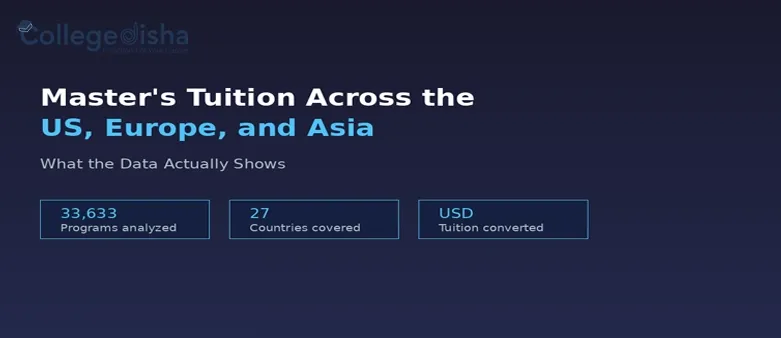
Master's Tuition Across the US, Europe, and Asia: What the Data Actually Shows
Ask an Indian student what a master’s degree costs abroad and the answer usually starts with the US. Sixty to seventy lakhs. Maybe more for a top school. The number is accurate. The problem is that students anchor on it and evaluate every other country relative to the US price, when most of the world charges a fraction of what American universities do.
A recent analysis of 33,633 master’s programs across 27 countries, published at GradsMatch Research, puts hard numbers on the gap. Here is what it shows and what it means for students making real decisions.
The Headline Numbers
The median total tuition for a US master’s program is $61,770 (based on 9,508 programs with verified tuition data). That puts the US in a class of its own. Only Australia comes close, with medians above $60,000 at many institutions.
Continental Europe is a different world:
- Germany: Under $500 total at most public universities
- France: Around $4,100 per year for non-EU students (Campus France)
- Italy: $3,000 to $7,000 total, on a sliding scale based on family income
- Spain: $3,000 to $5,000 total at public universities
- Belgium: $1,000 to $5,000 per year
Asia offers a middle ground:
- South Korea: $6,000 to $12,000 total; government scholarships (GKS) can bring it to zero
- Japan: $5,000 to $15,000 per year; MEXT scholarships cover full costs for selected students
- Singapore: $15,000 to $30,000 total, but institutions like NUS and NTU are ranked in the global top 15
These are not cherry-picked examples. They represent medians across thousands of verified programs.
Why the Gap Exists (And Why It Is Not About Quality)
The difference has nothing to do with educational quality. It is a funding-model difference.
In the US, universities charge market-rate tuition. A state school might charge $15,000 per year for in-state residents and $35,000 for everyone else. Private schools charge $50,000 to $70,000 regardless. The system is built on loans, endowments, and out-of-state premiums.
In Germany, higher education is publicly funded. The federal and state governments cover university operating costs, and tuition is either zero or close to it. The DAAD confirms this applies to international students as well.
In East Asia, governments subsidize tuition through scholarship programs. South Korea’s GKS and Japan’s MEXT both cover tuition, living expenses, and travel for selected students. Even without these scholarships, tuition at public universities in both countries is a fraction of US prices.
The result is that ETH Zurich, ranked 7th globally, charges about $1,600 per year. Technical University of Munich, ranked 30th, charges zero tuition. Georgia Tech’s online MS in Computer Science costs $10,260 total. These programs sit alongside US schools charging $60,000 to $130,000 for similar degrees.
The Field Does Not Change the Pattern
One common assumption is that STEM programs are expensive everywhere. The data does not support this.
In Computer Science, the US median is $62,000. Germany’s median is effectively $0 at public universities. Italy sits at about $7,000. The same pattern repeats in engineering, business, public health, and the social sciences.
The only field where the gap narrows somewhat is MBA programs, where European business schools (especially in France and the UK) charge premium rates that approach US levels. But even there, a public university MBA in Spain or Italy costs a tenth of what a US MBA does.
What Indian Students Miss in the Comparison
Application Fees
The median application fee for a US master’s program is $85. Apply to 10 schools and that is $850 in non-refundable fees. Many European programs, especially in Germany and the Nordics, charge nothing to apply.
Test Requirements
Most European master’s programs do not require the GRE. The GRE costs $220 (per ETS), and the preparation time is significant. Students who skip the GRE and apply to European programs save both money and months of study time.
Program Duration
Most UK and many European master’s programs are one year. US programs are typically two years. That extra year means double the living costs, double the insurance, and a full year of lost salary.
A one-year UK master’s at GBP 25,000 tuition plus GBP 12,000 living costs totals roughly $47,000. A two-year US master’s at $30,000 per year tuition plus $20,000 per year living costs totals $100,000. The per-year rate in the UK looks high, but the total cost is half.
Post-Study Work Visas
The work visa situation should matter as much as tuition:
- Germany: 18 months for all graduates
- Canada: up to 3 years (PGWP)
- UK: 2 years (Graduate Route)
- US: 1 year OPT, 3 years for STEM
- Australia: 2 to 4 years
Students who want to work abroad after their master’s should weight the visa duration heavily, especially given how competitive the US H-1B lottery has become.
How to Use This Information
Do not pick a country and then find programs within it. That approach guarantees you miss options. Instead:
- Set a total budget that includes tuition plus two years of living expenses
- Decide whether you are willing to take the GRE
- Filter by your field and preferred language of instruction
- Compare what survives those filters across all countries at once
The programs that pass your filters are the ones worth investing time in. The country is an output of that process, not an input.
University websites make this comparison difficult because every school formats tuition differently, uses a different currency, and buries deadlines in different places. Tools that convert this data across countries exist specifically to solve that problem, and they are worth using before you commit to a country based on brand recognition alone.
The Bottom Line
The assumption that a good master’s degree costs $60,000 or more is an American assumption. Most of the world educates graduate students for under $10,000 in total tuition, and some of the programs that do it are ranked in the global top 30.
The data is clear. The question is whether students will look at it before they apply or only after they have already signed a loan.
Antoine Pangas is the founder of GradsMatch, a free directory of 39,926 master’s programs across 27 countries with tuition converted to USD.

Related Articles



Copyright @2026.www.collegedisha.com. All rights reserved